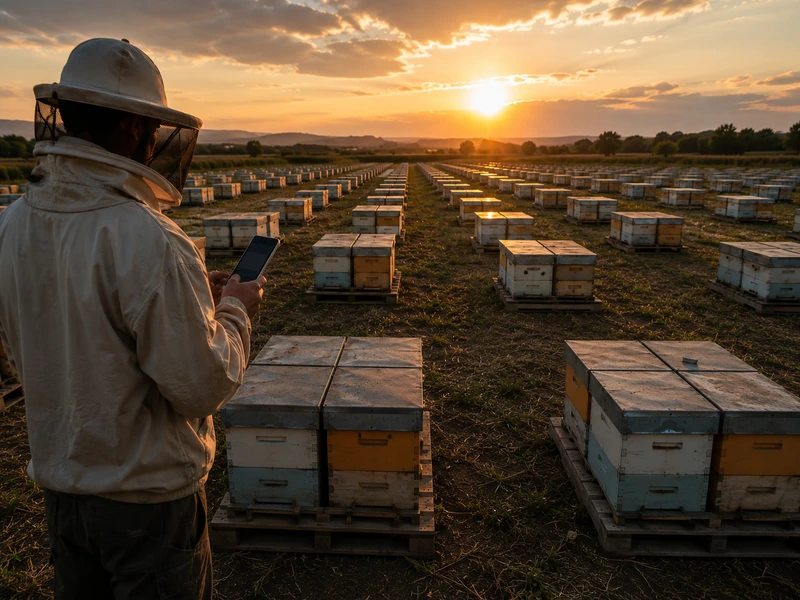

BeeHero’s In-Hive Sensors produce observations about the technical performance of bee hives. Our raw algorithmic model turns these into estimates of the number of bee “frames” in the hives (a frame is the highest level of precision to which a colony can be measured. A typical hive has 16 to 20 frames inside and we estimate how many frames are covered at least 75% or more by bees). Our calibration process maps these estimates into a count of Bee Frames specific to an individual population and setup.
Independent evaluations — including field inspections by third-parties — ask whether our calibrated estimates hold up to reality without feeding the same loop that produced it. Following this process, a review loop, increasingly supported by internally-built, AI-powered agents, asks 3 questions:
To answer these questions, BeeHero’s model-monitoring does not rely on flawless automation - instead, it is a story about review quality.
BeeHero’s hive grading process starts with sensor readings from the hive. These readings are cleaned, aligned with ambient measurements (for example: weather data), and converted into signatures which describe hive behavior over time. This is the initial model path: raw data in, uncalibrated estimate out.
A separate calibration layer then maps those raw outputs onto a Bee Frame scale for the relevant population and hive setup. Calibration is an adjustment for a specific population and period. It is not, by itself, proof that the adjusted estimate is correct in the field.
Independent evaluation sits outside both. Field inspections play that role: they are a success signal and a check on whether calibrated estimates hold up under real sampling, not the input that sets the calibration itself. Keeping that separation in place is important. If the same inspections simultaneously create the mapping and declare it successful, the review becomes circular and loses its independence. Evaluation remains useful when it can disagree with the calibrated result.
That is why review starts with evidence rather than instinct. Before anyone decides that a calibration looks better, the system needs to show what improved, for which hives, on which dates, and under which model version — and whether an independent check still supports the change.
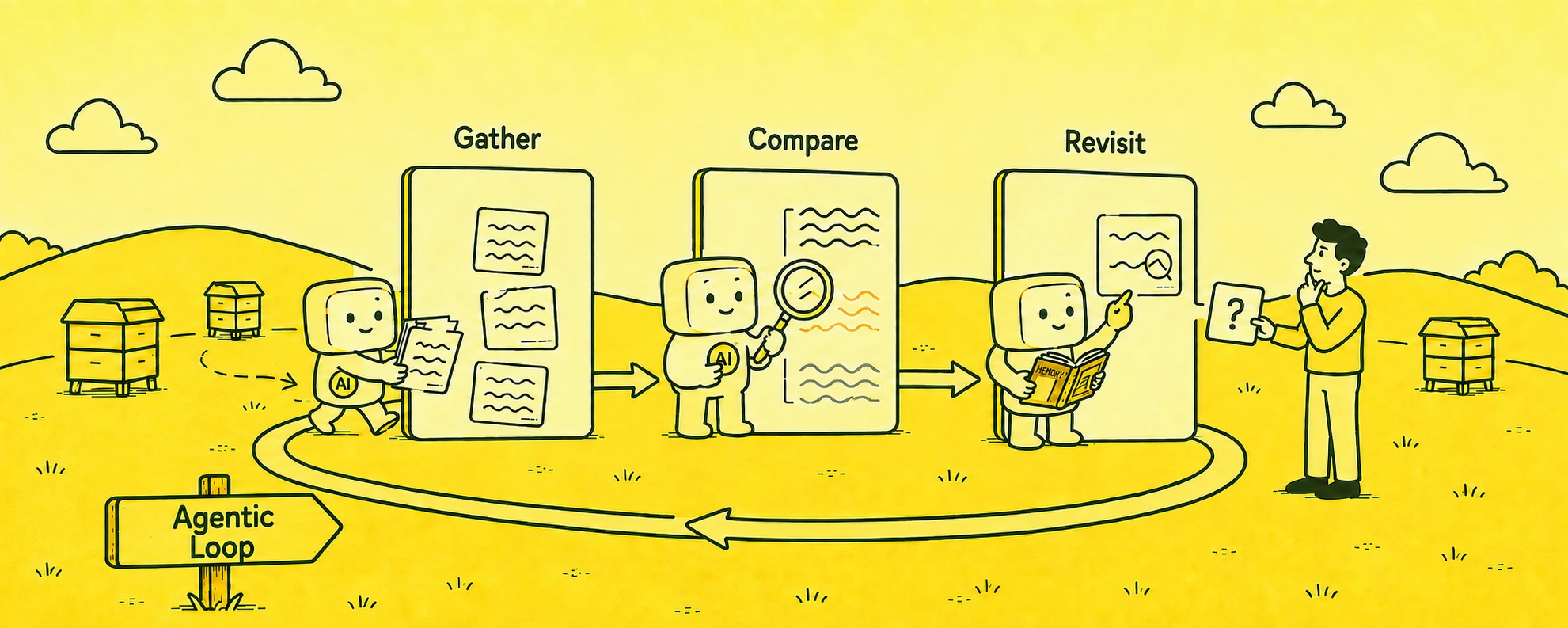
Once a model is deployed, the job becomes repetitive in the best sense of the word. Algorithmic code calculates metrics and checks data requirements. Agents use review tools to inspect those results, compare them with earlier runs, and record an assessment with the reason behind it.
A deliberate boundary is incorporated into this process. Agents can organize evidence, flag gaps, and recommend a next step. They do not create a new model or a new calibration on their own. Those changes require a human to approve them and a separate verification pass after the change is applied.
Fair comparison is precise here. First, we put a candidate and a baseline on matched data: the same hives, dates, and pipeline conditions wherever possible. Then, we test one fixed change across several dates and field conditions, while accounting for coverage gaps, population mix, environmental differences, and pipeline version differences. Without those controls, an apparent improvement may say more about missing observations or a shifting setup than about a better estimate.
The review also checks measurements-profile coverage. Where the workflow supports it, missing profiles trigger a bounded retrieval attempt. If the data still cannot be recovered, the gap stays visible rather than quietly disappearing. The question evolves from "does this look right?" to "what evidence do we actually have?"
The review loop avoids trusting any single chart too much. Our internal agents examine several views together: prediction distributions, measurement profiles grouped by predicted strength, and the calibration response curve.
Each view catches a different failure. The response curve can expose saturation, where different inputs collapse into the same capped estimate. Profile comparisons can show distinct hive behaviors compressed into one predicted strength band. On paper the output may still look tidy. In practice, the model is losing resolution where the team needs it.
Ambient context matters, too. For example, hive temperature should sometimes move together with outside conditions, though not every variance in this regard is suspicious. When a pattern persists after accounting for the environmental factors, it deserves further attention. Our review process considers how many hives are affected and whether the main strength groups are still distinguishable enough to support a real-world decision.
A review does not start from scratch every time. It carries forward the reasons why a previous review may have struggled. If yesterday’s concern was poor profile separation, a thin high-strength tail, or another specific weakness, today’s review has to answer that exact objection. A nicer average is not enough. The question is whether the earlier challenges were actually cleared.
The same discipline applies when testing a proposed calibration change across several dates. BeeHero does not want a different "best" setting selected independently for each day just because that produces better-looking plots. The candidate change stays fixed while the review walks it across dates and conditions, so the outcome reflects a consistent choice rather than a moving target.
Agents are good at that persistence. They can repeat checks, gather the same evidence package every time, and keep the reasoning attached to the result. If the evidence remains incomplete or contradictory, the workflow preserves a `needs_review` state instead of pretending that the uncertainty has been resolved.
Human review still matters, especially in agriculture, where unusual configurations, unfamiliar weather patterns and varying field conditions are constantly influencing the results. The goal is not to eliminate people from the loop. It is to assign them a higher value-added question — and to keep approval of model or calibration changes in human hands.
When an item stays in `needs_review`, the human reviewer is not asked to re-run the entire investigation from zero. Algorithmic tools have already computed the metrics. The agent has organized the evidence, checked the data requirements, surfaced the missing pieces, and compared the current result with earlier failures. What remains is a more important decision: is this shift explained by weather, by a different hive configuration, or by a calibration problem that still needs an approved fix and a verification pass?
That is a better use of human expertise. Much of BeeHero’s accumulated knowledge can be expressed in code and review procedures. Unfamiliar cases still require human judgment. The loop helps reserve human attention for exactly those cases.
Independent evaluation remains essential because both sides can be wrong. A manual inspection sample can be flawed or biased, for multiple reasons. The model or its calibration may also be wrong. Neither gets an automatic pass.
BeeHero has seen both patterns. In some cases, broader manual inspections showed that the BeeHero model was right and the sample had misled the team. In other cases, the model had drifted into underestimation or overestimation and needed correction. Repeated review loops and calibration fixes have reduced these recurring mismatches, but they have not eliminated uncertainty altogether.
That last part matters just as much externally as it does for us internally. When a hive grade estimate changes materially, a significant part of the work becomes explaining the evidence and the correction decision to our customers. Trust is not built by quietly swapping one number for another. It is built by showing what was checked, what stayed uncertain, and why our team made the decision it did.
That is what "watching the models" looks like in practice. Not bigger dashboards - better discipline. Algorithmic tools compute. Agents assess. But humans approve of the changes that matter. The estimate matters, but the review loop around it is what makes it valuable and relevant for the field.